Plans for local government reform in England have been put on hold, and in some cases scrapped completely, in the light of new legal advice and ongoing judicial reviews.
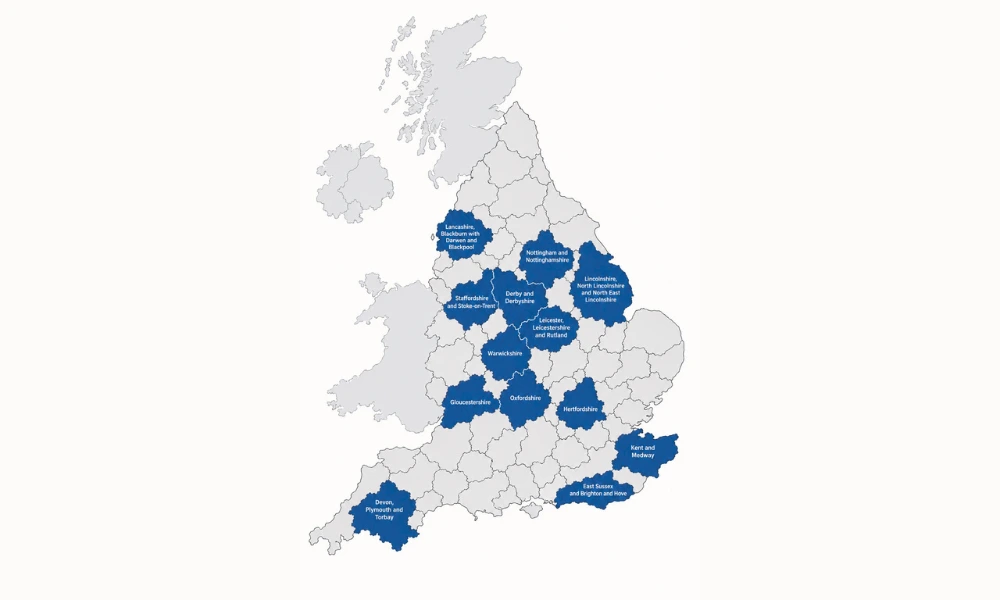
Plans for new, larger unitary authorities in Essex, Hampshire, Norfolk and Suffolk have been taken off the table completely, whilst 14 other areas are waiting to hear their fate. The pauses apply to:
- Derby and Derbyshire
- Devon, Plymouth and Torbay
- East Sussex and Brighton
- Gloucestershire
- Hertfordshire
- Kent and Medway
- Lancashire, Blackburn with Darwen and Blackpool
- Leicester, Leicestershire and Rutland
- Lincolnshire, North Lincolnshire and North East Lincolnshire
- Nottingham and Nottinghamshire
- Oxfordshire and West Berkshire
- Staffordshire and Stoke-on-Trent
- Warwickshire
The main exception is for Surrey, where councillors for two new unitary authorities have already been elected, and changes are currently underway.
The Government is suggesting that this is a temporary pause, with Local Government Secretary Angela Rayner saying she wants to be satisfied with the legalities and robustness of the process before reforms are pushed through.
It’s a stumbling block for Prime Minister Andy Burnham, who is keen to devolve more powers to local government, and it’s a frustration for planners and developers facinguncertainty across large parts of the country.
What was the plan?
Whilst many areas of England already have unitary authorities, the idea was to standardise local government structures to remove the old two-tier district and county councils.
Advocates say that unitary authorities bring benefits in terms of efficiency and simplicity of decision-making, and align better with plans for devolved powers.
Critics argue that unitary authorities are further removed from local representation and that smaller communities may be overlooked in favour of larger conurbations.
In opposition to the proposals, in June, Reform-led councils in Essex, Norfolk and Suffolk, and the Conservative-led administration in Hampshire, launched judicial reviews against the plans.
What are the implications for the planning system?
Whilst uncertainty isn’t generally welcomed in the planning sphere, the pause may reduce distraction in the short term and allow Local Authorities to focus on pressing issues, such as housing delivery and infrastructure projects.
However, without any clarity over timescales, the system is somewhat in limbo. With many LAs already committing staff and resources to reorganisation, there will be questions over recruitment, officer capacity and the ability of the planning system to pivot back to the ‘old system’ in the short to medium term (or perhaps even longer).
What could the timescales look like?
With no confirmed timetable for the Government's review, local government reorganisation could become a slow burner.
For now, existing council structures remain in place and local elections in 2027 will proceed on current boundaries.
For developers, planners and landowners it means business as usual until we are informed otherwise, although how efficiently this business is conducted by Local Authorities remains to be seen! Current committees and local plans remain in situ – for now.
What are the implications for housing delivery?
Uncertainty rarely helps housing delivery. Many authorities have already invested significant time and resources into preparing for reorganisation, and there is a risk that local plan preparation, evidence gathering and wider growth strategies have already lost momentum as a result.
The main question is whether the uncertainty created by the pause leads to further delays in plan-making and strategic decision-making.
Ultimately, the greatest risk is not that housing delivery stops, but that it slows. At a time when the Government is seeking to accelerate housebuilding, any distraction from preparing local plans, allocating sites and determining applications could make that challenge even harder.
“It’s another unwelcome distraction for the planning and development sector. At a time when we need clarity and certainty to deliver the properties and infrastructure the country desperately needs, many places find themselves in limbo.
“Of course it is vital to ensure that any reforms are well-thought-out, well executedand above all, legal, but these questions should have been answered long before changes were enacted.
“One thing the planning system has learned in recent years is that flexibility is vital. Politics moves at a blisteringly fast pace these days, and whilst being able to plan ahead helps everyone, perhaps the only certainty we have is uncertainty.
“Our best advice at the moment is business as usual, but be prepared for delays and keep your finger on the pulse!”
Andrew Metcalfe, Managing Director
Get in touch
If you have questions about what changes to local government could mean for your development project, the team at Squires Planning are here to help.
Get in touch today for a no-obligation chat.